
Exploring the Intersection of Art and Medicine: Introducing the ArtMedDx (AMDx) Medical Arts Database
My work as an art historian began, like many others, with questions of style, symbolism, and historical context. Over time, however, my attention kept returning to something more specific: signs of illness. While studying paintings, sculptures, and manuscripts, I repeatedly encountered bodies bearing quiet traces of disease - swollen necks, asymmetrical jaws, distorted limbs, clouded eyes. These were not medical illustrations but devotional images, court portraits, and ritual objects - yet they recorded illness all the same.
Those moments of recognition reshaped how I looked and how I searched. I had already been engaged with the medical humanities through teaching pre-med and health science majors in courses such as Medical Arts Observation and Art and Anatomy in Italy, which incorporated museum visits and hands-on study of anatomy in art. Entering terms like anatomy, illness, physician, doctor, and disease into museums’ permanent collection databases, I tested whether institutional systems could surface what the images themselves revealed. This process led me toward deeper interdisciplinary work at the intersection of the visual arts and healthcare. As a Professor of Art History at Missouri Southern State University and a Visiting Scholar with the Visual Arts in Healthcare Program at Brigham and Women’s Hospital, I now work directly in this space. My ongoing appointment at VAH-BWH continues to expand these conversations and shapes a variety of projects, particularly one I developed independently: the ArtMedDx (AMDx) Medical Arts Database.
AMDx began nearly six years ago as a solitary, museum-based initiative. Over time, it evolved through dialogue with physicians, clinicians, and scholars who recognized the value of close looking as a diagnostic and pedagogical skill. Early conversations with healthcare clinicians and art educators strengthened its interdisciplinary foundation. Transatlantic collaborators expanded its global scope. Today, AMDx continues to grow with contributions from art historians, physicians, and medical educators across the U.S. and Europe, bringing diverse perspectives to a shared inquiry.
At its core, AMDx relies on close visual analysis informed by archival research. The database now includes nearly 700 works identified through museum collections, medical libraries, and academic archives. Each image is classified using an A-Z disease taxonomy developed collaboratively with medical professionals and modeled on contemporary systems while remaining historically and culturally grounded. Every entry pairs art historical interpretation with medical analysis, allowing artworks to be read simultaneously as cultural artifacts and records of embodied illness.
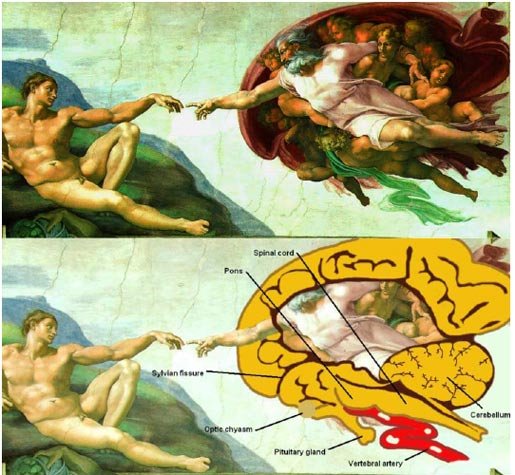
Michaelangelo, Sistine Chapel
Some works reveal disease through subtle anatomical allusion. Michelangelo’s Creation of Adam may embed a visual reference to the human brain, merging divine creation with anatomical knowledge. Seventeenth-century portraits of Charles II of Spain document the genetic consequences of dynastic intermarriage. African sculptural figures with enlarged necks reflect endemic iodine deficiency, while medieval Islamic manuscripts depict dental decay through humoral and spiritual frameworks. Together, these works show how illness has long been observed, interpreted, and embedded in visual culture.

Juan Carreno de Miranda, Charles II of Spain
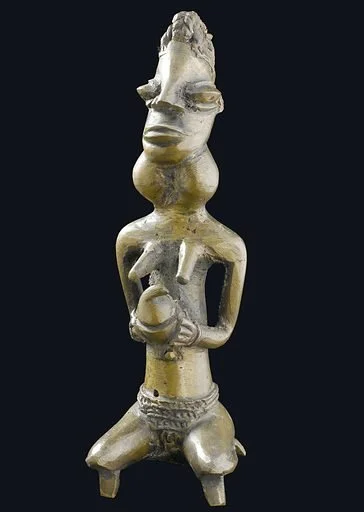
Nigerian woman
AMDx is now expanding into a digital platform for research and education. We are developing a website to open the database to scholars, clinicians, educators, and students, inviting them to discover the subtle traces of illness recorded in art. Thoughtfully integrated, these systems help users navigate, cross-reference, and interact with the collection while keeping human scholarly interpretation and clinical insight at its heart.
Ultimately, ArtMedDx asks us to look again - to see visual art not only as aesthetic expression but as a record of health, illness, and care. Through global collaboration across disciplines and institutions, the project demonstrates that art and medicine have never been separate ways of knowing. They are complementary practices, each deepening our understanding of illness and the human body, one image at a time.

Christine Bentley, PhD, Visiting Scholar, Visual Arts in Healthcare Program, Brigham and Women’s Hospital Professor of Art History, Missouri Southern State University
Acknowledgements and Collaborators
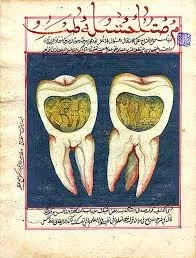
Islamic manuscript
The ArtMedDx (AMDx) Medical Arts Database is the result of sustained interdisciplinary collaboration to include scholars and clinicians in art history, medical history, and clinical practice from institutions across the United States and internationally: Director Brooke DiGiovanni Evans, Dr. Giampaolo Martinelli (MD, England), Dr. Francesca Rubulotta (PhD/ MBA, Sicily), Dr. Vincenza Ferrara (PhD, Italy). Christina Olszewski (MA, Australia), and in the USA Dr. Joel Katz (MD), Dr. Michael Stanley (MD), Dr. Bernard de Bono (MD, PhD), Dr. Elizabeth Morton (PhD), Dr. Donna Johnson (DVM), Dr. Victoria Rhodes (PhD), Dr. Ree Wells Lewis (PhD), Dr. Cathy Shin (MD), Dr. Tamara Kaplan (MD), Dr. Cheyenne Pettit (PhD), Prof. Elmira Bagherzadeh (MFA), Dr. Amber Mintert (ED, MS), Mason Clark (Software Development), Michael Motec (HMS Med Student), Nazanin Moghbeli (MD and artist) and Maria Burdjalov (Einstein Med Student).